
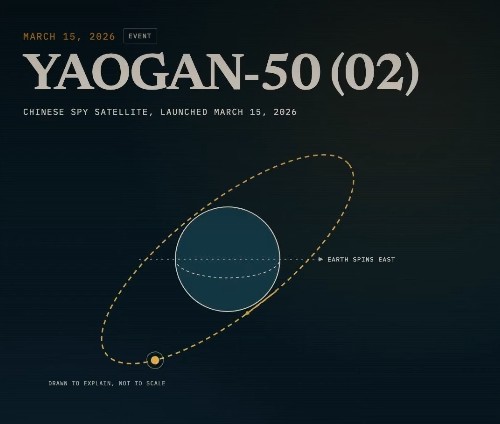
China’s Yaogan satellites are a long‑running series of military reconnaissance spacecraft designed for high‑resolution Earth observation, electronic intelligence gathering, and maritime surveillance. They typically operate in sun‑synchronous orbit, which allows them to pass over the same regions at consistent lighting conditions — ideal for imaging and radar work. Different Yaogan variants carry optical cameras, synthetic aperture radar, or signals‑intelligence payloads, giving China the ability to monitor ground activity, track naval vessels, and intercept electromagnetic emissions. Because these satellites rely on extremely precise orbital timing to perform surveillance, even small disturbances — such as gravitational perturbations, micro‑impacts from debris, or slight thruster errors can cause orbital drift, gradually shifting their ground track and reducing the accuracy of their reconnaissance passes. This sensitivity is why Yaogan satellites are often discussed in the context of orbital stability and how minor forces can influence a spy satellite’s effectiveness. | Chain of interest | September 17, 2026
👁
Related Information: Flock CEO hides his home on Google Maps, internet marks it “Public Toilet” | September 28, 2026